



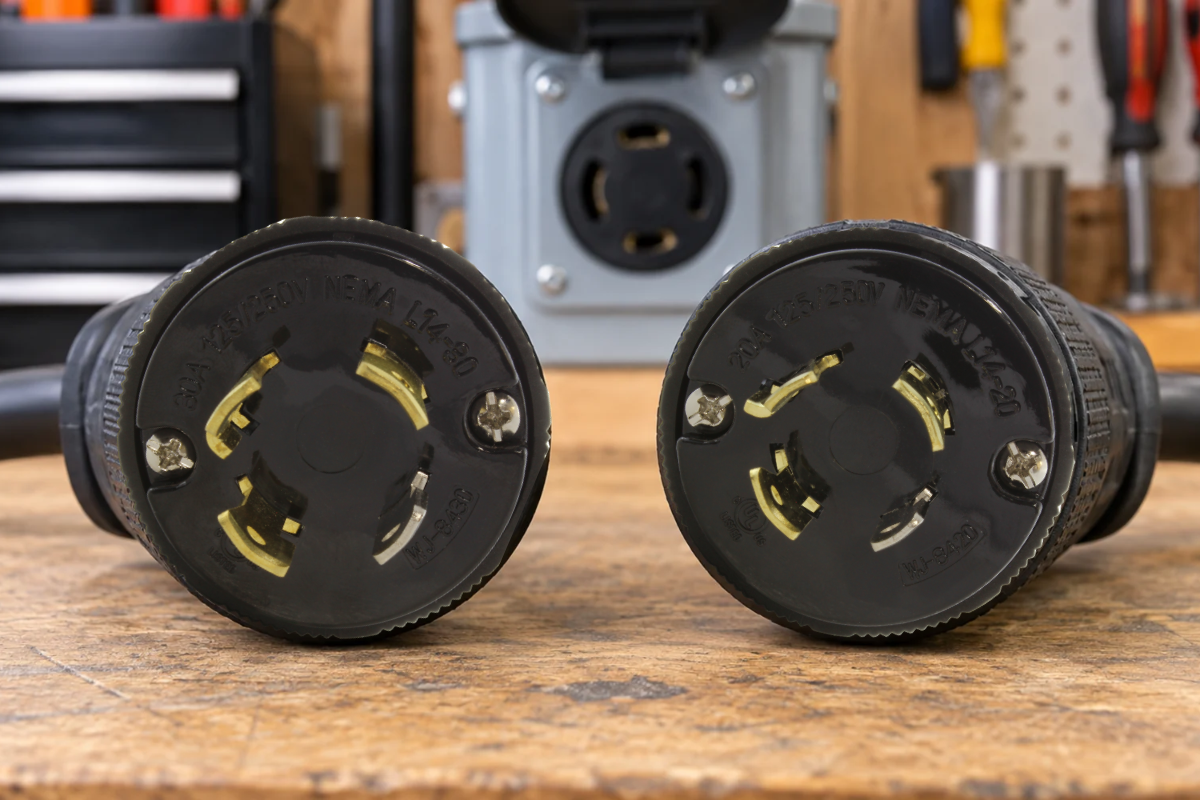
The fastest way to tell NEMA L14-20 and L14-30 locking connections apart is to inspect the grounding prong. On an L14-20 connection, the grounding prong has a section that points outward or up. On an L14-30 connection, that grounding prong turns inward or down. Always confirm the complete configuration before connecting equipment.
What Is the Difference Between L14-20 and L14-30?
NEMA L14-20 and L14-30 are both four-prong locking configurations. Their circular layouts can look nearly identical at first, especially when you are comparing an inlet, outlet, plug, or connector. The grounding-prong orientation is the clearest visual clue.
Quick Comparison
- L14-20: Four-prong locking configuration with the grounding prong pointing outward or up; the transcript identifies a 5,000-watt power capability.
- L14-30: Four-prong locking configuration with the grounding prong pointing inward or down; the transcript identifies a 7,500-watt power capability.
- Identification rule: Check the grounding-prong direction on the connection itself and on the matching plug or connector.
How to Identify an L14-20 or L14-30 Connection
- Turn off and disconnect power before inspecting the connection.
- Confirm that the connection has four prongs arranged in a circular locking pattern.
- Find the grounding prong. An outward or upward section indicates L14-20; an inward or downward section indicates L14-30.
- Verify the NEMA marking and match the inlet, outlet, plug, connector, cord, and adapter before use.
Do not rely on the overall circular shape alone. The two configurations are similar enough that the grounding-prong detail matters.
Why L14-20 and L14-30 Are Easy to Confuse
Both configurations use four prongs in a circular locking layout. The same visual distinction applies whether you are looking at an inlet, outlet, plug, or connector: L14-20 has the grounding feature projecting outward or up, while L14-30 turns it inward or down.
Matching Household-Plug Adapters to Inlet Boxes
The source video compares two AC WORKS® adapters that connect a standard household plug to a locking inlet-box connection:
- AD515L1420 is intended for an L14-20 inlet box.
- AD515L1430 is intended for an L14-30 inlet box.
These adapters may support small-appliance use during a power outage, but the connection type and total electrical load still have to match the source and equipment. An adapter does not increase the capacity of the supplying circuit.
Which Configuration Offers More Power?
In the comparison presented in the transcript, L14-20 provides up to 5,000 watts while L14-30 provides up to 7,500 watts. That higher potential is why L14-30 may be preferred when more power is needed. Capacity alone does not determine compatibility: use the configuration that matches the installed inlet, wiring, source, and load.
Safety Before You Connect
- Never force a plug or connector into a different locking configuration.
- Inspect only with power off and the equipment disconnected.
- Confirm the NEMA marking rather than relying only on appearance.
- Use a licensed electrician to install or change an inlet, transfer equipment, or fixed wiring, or whenever the connection cannot be identified confidently.
Frequently Asked Questions
How can I quickly identify L14-20 versus L14-30?
Check the grounding prong. L14-20 points outward or up; L14-30 points inward or down.
Do L14-20 and L14-30 have the same prong layout?
They are both four-prong locking configurations with a similar circular pattern, but the grounding-prong orientation is different.
Can an L14-20 plug fit an L14-30 connection?
No. They are different NEMA configurations and should not be forced together. Match the exact plug, connector, inlet, or outlet.
Which has more power capability, L14-20 or L14-30?
The transcript identifies L14-20 at 5,000 watts and L14-30 at 7,500 watts. Actual use must still stay within the ratings of the complete setup.
When should I call a licensed electrician?
Use a licensed electrician for inlet or transfer-equipment installation, fixed-wiring changes, or any situation where the connection or load requirements are uncertain.
Share:
How to Identify Air Conditioner Power Plugs: NEMA 5-15, 5-20, 6-20, and 6-30