



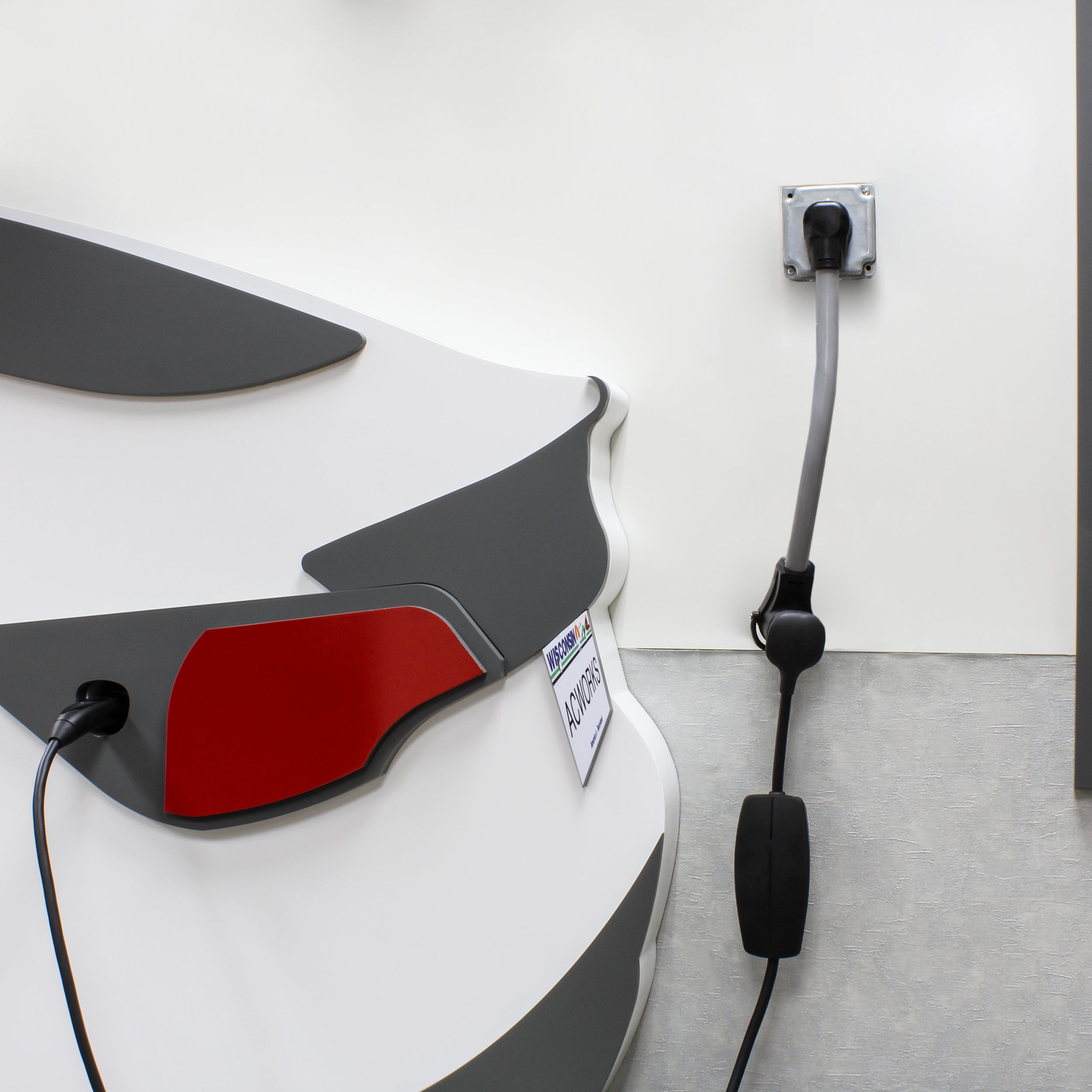
If you're new to owning an electric vehicle, you've probably heard the number 80% thrown around more than once. What you might not know is that there are actually two separate 80% rules, and they cover very different parts of your charging setup.
One has to do with how full you let your battery get. The other has to do with how hard you push the outlet you're plugged into.
Mixing the two up, or ignoring either one, can shorten your battery's life or damage the outlet and power cords you're relying on.
Rule One: Meet Your Battery's Comfort Zone
The first rule is about your car itself. For everyday EV charging, most manufacturers recommend stopping around 80% instead of topping off to 100% every time you plug in.
Why 80% Charges Faster
Once a battery crosses that 80% mark, the charging rate slows down considerably to protect the cells inside. A Tesla Model 3 on a supercharger might go from 10% to 80% in about 30 minutes, but squeezing out that last 20% could tack on another full hour.
What That Means on a Road Trip
If you're on a road trip with a schedule to keep, stopping at 80% gets you back on the road much faster than waiting around for a nearly full tank. That time savings adds up fast when you have several stops ahead of you.

Rule One Also Protects Battery Longevity
Constantly draining your EV to near zero and then charging all the way to 100% puts extra strain on the battery over time. Keeping your charge generally between 20% and 80% is gentler on the cells and can help the battery hold its capacity for longer, much like the advice people give about phone batteries.
A Real Life Example
Picture an EV with a 300 mile range. Charging to 80% still gives you roughly 240 miles, which is plenty for most daily driving and even longer trips with a couple of stops. Of course, this isn't a rule set in stone. There are situations, like a long stretch with no charging stations nearby or a cold winter drive, where charging all the way up simply makes more sense.
Rule Two: Respect Your Outlet's Real Limit
The second 80% rule has nothing to do with your car's screen and everything to do with the outlet you're plugging into. This rule says you should only draw 80% of whatever amperage that outlet is rated for, not the full number printed on the breaker.
Matching Amps to Outlet Type
A 50 amp outlet should be limited to about 40 amps of EV charging. A 30 amp outlet, the kind you'd typically find running a dryer, should be capped around 24 amps, and a 20 amp outlet should stay closer to 16 amps. If you're charging off a dryer outlet, our Dryer Extension Cord (1430PR) is one of our most popular picks for exactly this setup.
A Welder Outlet Option Too
Some EV owners charge off the same outlet they use for a welder in the garage. For that setup, our EV Charging Adapter (EV1050MS) is a popular choice in the USA and our EV Charging Adapter EV650MS-018 will work perfectly in Canada and elsewhere. Rest assured, the same 80% math applies no matter which outlet you're adapting to.

A Quick Reference Chart
Since the exact numbers can be easy to forget, here's a simple breakdown of common outlet types and their 80% charging limit.
Outlet Rating |
Common Outlet Type |
Safe Charging Limit (80%) |
50 Amps |
NEMA 14-50 |
40 Amps |
30 Amps |
NEMA 10-30 / 14-30 (dryer) |
24 Amps |
20 Amps |
Standard 20A outlet |
16 Amps |
Keep this chart handy so you can double check your charging limit no matter which outlet you're using, whether it's at home, at a friend's garage, or out on the road. Charging off a standard 20 amp home outlet? Our SD520PR Extension Cord is a popular option built to handle that kind of everyday use.
Adapters That Do the Math for You
Most EVs ship with an adapter system that lets you switch between outlet types depending on where you are. Many adapters, including AC WORKS® G2 EV adapters, have a built in chip that automatically sets your charging amperage to that safe 80% mark for you.
When Adapters Don't Have a Chip
Not every adapter on the market has this feature, and that's where people run into trouble. We've had customers reach out because their EV mysteriously stopped charging mid-session, only to find out they were pulling 32 amps from a 30 amp outlet.
Why Overdrawing Is a Real Risk
That kind of overdraw generates a lot of heat in the outlet, the switch, and the power cords involved. Over time that heat can ruin your power cords or your outlet, so setting your charging limit correctly from the start matters more than it might seem.
Sharing an Outlet? The Same Math Applies
If you use a two-way switch setup, such as our EVY1430SW-36, so you can share one outlet between an appliance and your EV, the same math applies. You'd still want to cap your EV charging around 24 amps on that 30 amp circuit, even with the switch doing the work of keeping both devices from running at once.

Frequently Asked Questions
Why should I stop charging my EV at 80% instead of 100%? Charging speed slows down a lot once you cross 80%, so stopping there gets you back on the road faster. It also keeps your battery out of the extreme top of its range, which helps it hold its capacity for longer over time.
Does charging to 80% mean I'm losing a lot of range? Not really. On an EV with a 300 mile range, charging to 80% still gives you roughly 240 miles, which covers most daily driving and even longer trips with a stop or two along the way.
Is it ever okay to charge my EV to 100%? Yes. If you're facing a long stretch with no charging stations nearby, or it's a cold winter day and you want the extra range, charging all the way up makes sense.
What does the second 80% rule mean for home charging? It means you should only draw 80% of your outlet's rated amperage, not the full number on the breaker. A 50 amp outlet should be capped around 40 amps, a 30 amp dryer-style outlet around 24 amps, and a 20 amp outlet around 16 amps.
What happens if I charge above 80% of my outlet's rating? Overdrawing an outlet generates a lot of heat in the outlet, the switch, and the power cords involved, and over time that heat can ruin your power cords or your outlet. Adapters like our G2 EV adapters have a built in chip that automatically keeps you at that safe 80% mark.
Wrapping Up

The two 80% rules might sound like a coincidence, but they're really two separate safety nets working together. Watch our helpful video here! One protects the long term health of your battery by keeping you out of the extreme top and bottom of your charge range. The other protects your outlet, your power cords, and your home's electrical system from the heat that builds up during long, steady EV charging sessions. Following both rules is a small habit that pays off in fewer surprises and a battery that stays healthy for years. If you need the right gear to make it happen, browse our EV Charging Collection for adapters and cords built for exactly this. For more tips like this, check out the rest of our blogs on the AC WORKS® site.
#80PercentRule #ChargingTips #EVBatteryHealth #HomeCharging #ACWORKS #PowerSolutions #EVAdapters
Share:
A Better Way to Connect Generator Power
The Dangers of Double Male Ended Cords