



Generator Power Cord Adapters and Splitters: How to Use Every Outlet Safely
The short answer: you can get more useful connections from a portable generator by matching each receptacle to the correct NEMA adapter or splitter, but every connected load must stay within two limits: the breaker rating for that outlet circuit and the generator’s total running-watt capacity. An adapter adds connection options; it does not create more power.
That distinction matters on a job site, during flood restoration, or when supplying temporary household loads. A generator may have several outlet types, yet a single overloaded branch can trip even when the generator still has unused capacity elsewhere. The safest approach is to inventory every device, account for startup surge, and distribute the loads deliberately.
Generator Power Planning at a Glance
· Use running watts for the continuous load and starting watts for the brief surge when motors, pumps, compressors, vacuums, or fans start.
· Calculate watts with volts × amps = watts.
· Stay below each outlet circuit’s breaker rating, even if the generator has total wattage remaining.
· Stay below the generator’s rated running watts across all outlets combined.
· Match both ends by NEMA configuration and verify voltage, amperage, wiring, cable gauge, and product rating.
Running Watts vs. Starting Watts
Running watts are the power a device needs after it is operating normally. Starting watts, sometimes called surge watts, are the higher short-duration demand that appears when a motor starts. An industrial fan, vacuum, portable extractor, pump, refrigerator, or grinder may briefly draw considerably more power at startup than its nameplate running load suggests.
Build the load plan from the manufacturer’s watt or amp ratings for every device. Add the running watts for equipment that may operate at the same time, then allow for the largest likely startup surge. If several motor loads could start together, sequence them so the generator does not have to absorb every surge at once.
The Generator Wattage Formula
VOLTS × AMPS = WATTS
For example, a 125-volt circuit protected at 20 amps has a 2,500-watt mathematical ceiling: 125 V × 20 A = 2,500 W. A 125-volt, 30-amp circuit has a 3,750-watt ceiling. Those figures describe the circuit’s upper limit, not a target. The connected device, adapter, cord, generator instructions, and applicable electrical rules may require a lower load.
Common Generator Outlets and What They Can Do
|
Outlet |
Electrical rating |
Theoretical power |
How to plan the load |
|
NEMA 5-20R duplex |
125 V / 20 A circuit |
2,500 W per protected circuit |
Accepts 5-15P and 5-20P plugs when the receptacle has a T-slot. Treat both sockets on the same breaker as one shared circuit. |
|
NEMA L5-30R |
125 V / 30 A |
3,750 W |
A 3-prong locking outlet. An L5-30P distribution cord can provide household-style receptacles, but their combined load still cannot exceed the source circuit or cord rating. |
|
NEMA L14-30R |
125/250 V / 30 A |
7,500 W total |
A 4-prong locking outlet with two hot legs. A compatible power-distribution adapter can provide 120-volt receptacles across the two legs. Keep each leg within its permitted load and balance loads when practical. |
|
NEMA 14-50R |
125/250 V; receptacle rated up to 50 A |
Limited by generator and breaker |
A generator may protect this outlet below 50 amps. Use the generator breaker and running-watt rating as the real limits, not the receptacle name alone. |
Important: The ratings above are simplified planning figures. Always use the markings and instructions on the actual generator, breaker, cord, adapter, and connected equipment.
How to Use Generator Adapters and Splitters
1. Start with the source outlet
Read the marking beside the generator receptacle. A 5-20, L5-30, L14-30, and 14-50 are different configurations and may provide different voltages or wiring. The adapter’s male plug must match the generator outlet exactly; never force or modify a connector.
2. Identify the equipment plug
Most household-style equipment uses a NEMA 5-15P plug with two parallel blades and a grounding pin. A 5-20P plug has one blade turned perpendicular. A 5-20R T-slot receptacle can accept either style when the equipment voltage and rating are compatible.
3. Choose a listed, correctly rated distribution option
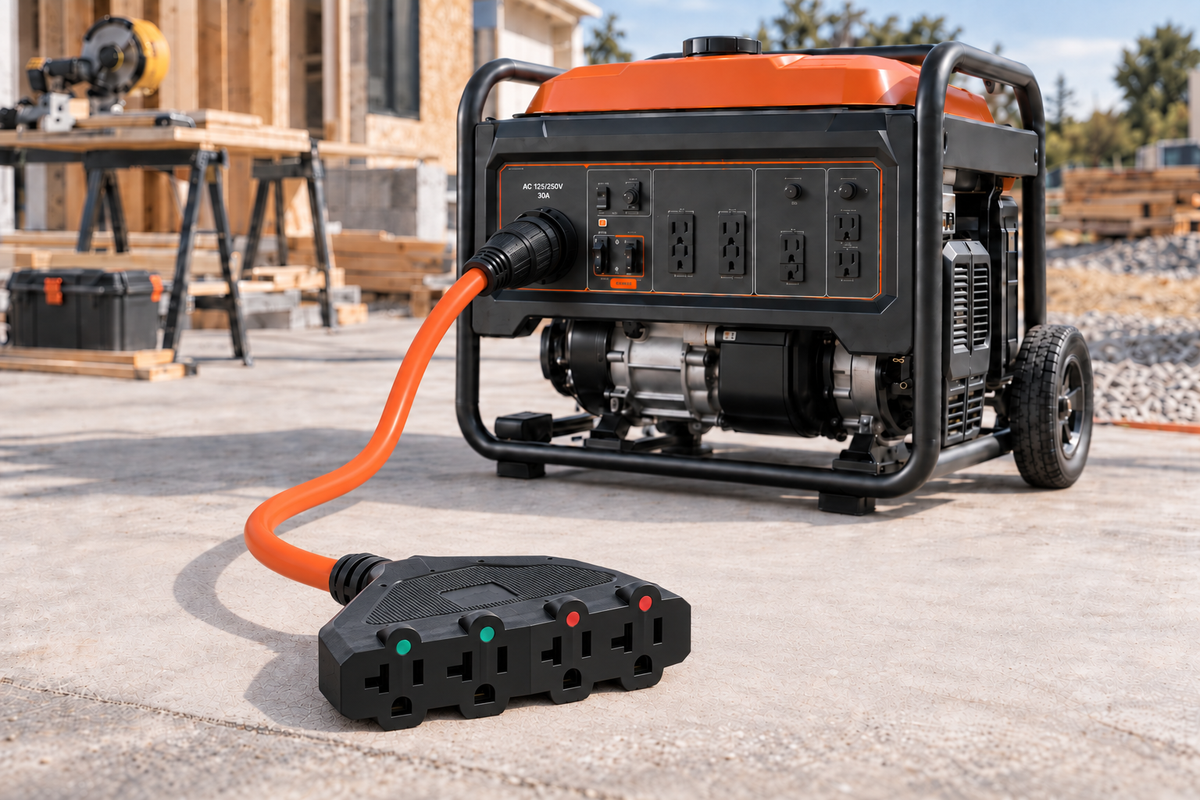
For an L5-30 generator outlet, an L5-30P to three NEMA 5-15R distribution cord can create three household-style connection points. The three loads still share the 30-amp, 125-volt source. AC WORKS also offers compact and flexible L5-30-to-5-20 options for a single or dual connection.
For an L14-30 generator outlet, an L14-30P to four NEMA 5-15/20R power-distribution cord can provide four household-style receptacles across the two hot legs. The outlets increase access, but the source remains limited to 30 amps per hot leg and the generator’s total capacity.
For a 14-50 outlet, a compatible 14-50P power-distribution adapter may provide four household-style receptacles. Check the generator’s actual breaker, the adapter cable rating, and the product’s availability and specifications before use. The 14-50 receptacle designation does not guarantee that a particular generator can deliver the full 50 amps.
4. Add loads by circuit, then by generator
Write down the amps or watts for each device. Place the loads under the outlet circuit that will supply them, total each circuit, and then total the complete generator. This two-level check prevents a common mistake: staying under the generator’s overall rating while overloading one branch circuit.
Example: A 10,000-Watt Generator Load Plan
Imagine a generator rated for 10,000 running watts with two 20-amp 125-volt duplex circuits, one L5-30 circuit, one L14-30 circuit, and a 14-50 outlet protected by the generator’s own breaker. You need to operate restoration fans, vacuums, and a portable extractor.
· A 12-amp, 125-volt vacuum uses about 1,500 running watts.
· A 10-amp, 125-volt fan bank uses about 1,250 running watts.
· Two 12-amp devices on an L5-30 distribution cord total 24 amps and about 3,000 watts, which remains below that 30-amp circuit’s theoretical ceiling.
· Three 15-amp devices would total 45 amps. A splitter does not make that acceptable on a 30-amp source; the branch breaker should trip.
Continue assigning equipment until every branch total and the generator-wide total are accounted for. Leave headroom for startup surge, and start larger motor loads one at a time. If the numbers do not fit, reduce simultaneous loads or use a properly sized power source.
Why a Generator Breaker Trips Even When Capacity Remains
A generator usually has a main limit and individual breakers for its outlet circuits. The main rating protects the generator as a whole, while a branch breaker protects a specific circuit. If one L5-30 circuit is asked for more than 30 amps, that breaker can trip even when another outlet is lightly loaded. Rebalancing loads across independent circuits may solve the problem, provided the generator-wide total stays within the rated running watts.
Generator Safety Rules That Should Never Be Optional
Use portable generators outdoors only. The U.S. Consumer Product Safety Commission advises operating a portable generator outside, at least 20 feet from the home, with exhaust directed away from the building. Keep working carbon-monoxide alarms in the home. Review CPSC generator safety guidance.
Never back-feed a building through a wall outlet. OSHA says a generator should not be attached directly to a structure’s electrical system unless a qualified electrician has installed a proper transfer switch. Back-Feeding can energize utility lines and expose workers and neighbors to electrocution. Read OSHA’s portable-generator guidance.
· Use grounded, undamaged cords rated for the connected watts or amps and intended environment.
· Keep the generator dry and follow the manufacturer’s operating and grounding instructions.
· Do not defeat breakers, GFCI protection, grounding, or other built-in safety devices.
· Turn the generator off and let it cool before refueling.
· Have a qualified electrician install any inlet box, transfer switch, or interlock used to supply premises wiring.
How to Find the Right Generator Adapter
Use the NEMA code on the generator as the male source configuration and the code on the equipment cord as the female load configuration. Then search the two configuration numbers together. For example, an L14-30 source feeding an L14-20 inlet can be searched as “L1430L1420.” This narrows the results to products with the correct ends.
The AC WORKS guide to finding the right power adapter explains this source-to-load method in more detail. Before ordering, confirm voltage, amperage, pin configuration, cord length, jacket type, approvals, and whether downstream overcurrent protection is included or required.
Frequently Asked Questions
Can I plug regular household appliances into a generator?
Yes, if the generator provides a compatible 120/125-volt household receptacle or you use a properly rated adapter from a compatible generator outlet. The appliance, cord, adapter, outlet circuit, and generator must all be electrically compatible, and the combined load must stay within every applicable limit.
What adapter converts a NEMA L5-30 generator outlet to household outlets?
Use an adapter or distribution cord with a NEMA L5-30P male plug on the generator side and NEMA 5-15R or 5-15/20R connectors on the equipment side. Add the amp draw of every connected device; all outputs still share the L5-30 source circuit.
How many watts can a NEMA L14-30 generator outlet provide?
At 250 volts and 30 amps, the theoretical total is 7,500 watts. When the outlet is split into 120/125-volt receptacles, the loads are distributed across two hot legs. Do not exceed 30 amps on either leg, the adapter’s rating, or the generator’s running-watt rating.
Can I use every outlet on my generator at the same time?
Possibly, but only when the sum of all loads stays below the generator’s running-watt rating and every individual outlet circuit remains below its breaker limit. Also account for the highest startup surge likely to occur.
Why does my generator breaker trip when I am under the total watt rating?
You may be overloading one branch circuit. A generator can have unused capacity on other outlets while a specific 20-amp or 30-amp breaker is overloaded. Map each device to its actual source circuit and rebalance compatible loads when possible.
Can I connect a portable generator to a wall outlet?
No. Never use a double-male cord or back-feed a home through a receptacle. To power premises wiring, use equipment such as a properly installed transfer switch or approved interlock and inlet arrangement, completed by a qualified electrician in accordance with the generator and equipment instructions and local requirements.
The Bottom Line
Generator adapters and splitters can make more of the power you already have accessible. The safe way to maximize a generator is to match NEMA configurations, calculate each device’s running and starting demand, respect every branch breaker, and keep the combined load under the generator’s continuous rating. When the math and the connections agree, a single generator can support a much more useful mix of tools, restoration equipment, and temporary household loads.
Need help matching a generator outlet to your equipment? Use the configuration markings on both ends and contact AC WORKS with the generator model, outlet type, equipment plug, voltage, amperage, and desired cord length.
Share:
Missing a Power Cord for Your PS5 or Xbox? Here's the Easiest Fix!
Dryer Outlet Safety Switch Y-Cable: Share Power Between a Dryer and EV Charger